



Overview
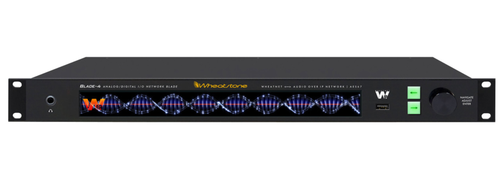
Wheatstone IP88-4A, Analog Blade 4
Blade 4 is Wheatstone’s fourth generation WheatNet-IP I/O unit and the most significant AoIP improvement to come out of recent times.
Unique to Blade 4 is its integration of key studio elements into one native AoIP environment, including audio processing, codecs, mixing, routing, control and operating system. It has a built-in OS for running apps and customized scripts for specialized software, metering apps and virtual interfaces.
Also included is Opus codec for streaming audio between the station studio and home studios, plus modern add-ons such as dual audio clip players, enhanced to play compressed or uncompressed audio files from the built-in USB ports, to virtually eliminate memory storage issues.
Blade 4 is fully AES67 compliant for interoperability with a wide range of AES67 networks and devices and supports SMPTE ST 2110, including the NMOS discovery standard for AES67 and next generation television networks.
Blade 4 puts both I/O and intelligence into one AoIP environment for everything from routing audio, mixing sounds and processing feeds, to turning mics on or off, controlling consoles and triggering mix-minus presets by show, location or talent.
These new functions are in addition to existing Blade features, such as two 8x2 stereo utility mixers for online mixing of sounds or segueing remotely between feeds; routable stereo processor with parametric equalizer, compressor and limiter; and 12 universal logic ports plus 128 software LIO ports, programmable as inputs or outputs, and routable through the network.
IP88ad is a hybrid access point for analog and digital audio. It has eight RJ-45 connectors for audio inputs. These can be set up as eight stereo, 16 mono, or any combination up to a maximum of 16 discreet channels. The first four Rj-45 jacks are set up as analog inputs. The second four are set up as AES digital inputs. It also has eight RJ-45 connectors for audio outputs. These can be set up as eight stereo, 16 mono, or any combination up to a maximum of 16 discreet channels. The first four Rj-45 jacks are set up as analog outputs. The last four RJ-45 jacks are set up as AES Digital outputs. The IP88ad has two more RJ-45 connectors to provide 12 logic ports, which can be individually designated during set up as inputs or outputs. These ports are where you wire the various external switches, indicators, and control functions you need in your facility. These are two RJ-45 jacks for Ethernet. Ethernet Port "A" is for the Gigabit Ethernet connections to your WNIP network. Port "B" can be selected during initial setup as a redundant WNIP connection, or as a WAN connection that can facilitate your use of BLADE-4's embedded CODECs.
Features
- Selectable Opus, MP3 and AAC codecs for integrating workflows from remote venues or home studios into the studio operation as needed. All codecs are routable in native AoIP; no additional studio hardware required.
- Built-in OS for running customized scripts and specialized software, metering apps and virtual interfaces.
- AES67 compliance, from .125 ms to 5 ms packets, for a wide range of interoperability with other AES67 devices and networks.
- Support for SMPTE ST 2110, including the NMOS discovery standard for AES67 and next generation television networks.
- Dual Ethernet ports available on every Blade 4 for failsafe redundancy.
- Integrated audio codecs, processing, mixing and operating system in one native AoIP environment for resource sharing.
- Two separate audio clip players, enhanced to play compressed or uncompressed audio files from the built in USB ports to virtually eliminate memory storage issues.
- Full AoIP I/O and intelligence in one unit for routing audio, mixing sounds, processing feeds, and controlling mics, consoles, and other studio appliances. Blade 4 has all the standard Blade features, including two 8x2 stereo utility mixers for online mixing of sounds or segueing remotely between feeds; routable stereo processor with parametric equalizer, compressor and limiter; and 12 universal logic ports plus 128 software LIO ports, programmable as inputs or outputs, and routable through the network.
- Codecs, software apps, mixing and audio processing, plus AoIP routing, control and interoperability in 1 RU for reducing rackroom real estate and associated cooling, cabling and other expenses.
Specifications / Documents