

Overview
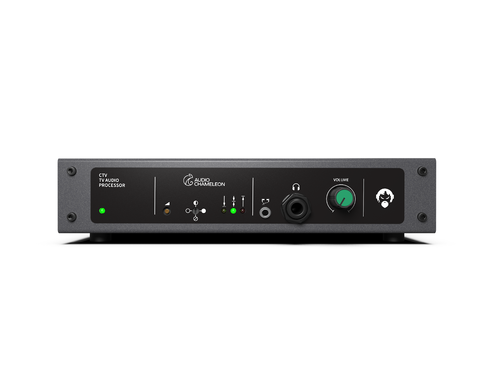
Angry Audio 991038, Chameleon TV Stereo Loudness Processor
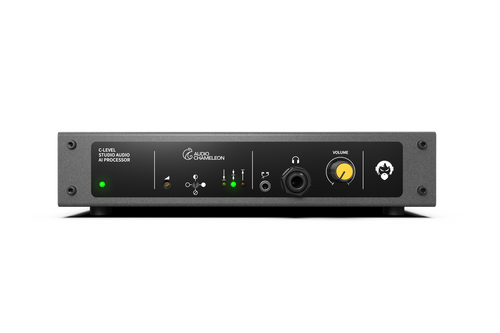
Chameleon TV is a stereo loudness processor for television and streaming audio. Adaptive multi-band processing analyzes the program and continuously adjusts its own parameters, holding a fixed −24 LUFS for ATSC A/85 (CALM Act) or any target from −24 to −16 LUFS for EBU R 128 and streaming platforms. Analog and AES/EBU I/O on XLR and StudioHub+; 4 ms latency.
An alternative to five-figure multiband program processors for facilities that need loudness compliance without surround, metadata management or a specialist to configure it.
Loudness standards are built on a measurement called LUFS (Loudness Units relative to Full Scale). Where a peak meter cares about the loudest instant, LUFS measures what humans actually perceive. It filters the audio the way your ear does — we tolerate loud bass far better than loud cymbals — and it averages over time, because a single snare hit bothers nobody, but forty seconds of screaming car-dealer ad clears the room. That’s why audio that “looks fine” on your console meter can be miles off target, and why no amount of fader-riding will fix it.
And the rules have teeth. In the US, the CALM Act makes TV loudness federal law: −24 LUFS, per ATSC A/85. Europe runs −23 under EBU R 128. Streaming platforms cluster around −16 — and while no government enforces that one, the platforms do. Miss the target and they’ll normalize your audio for you, their way, with all the care of Grandpa salting your food. Miss it badly enough and they’ll quietly bury your content.
Some broadcasters solve this with big program processors — impressive slabs of rack gear built for network plants, with price tags to match. They work beautifully. They also start at five figures, take a specialist to configure, and are mostly capability you’ll never touch: surround, dialog intelligence, metadata management, upmixing. If all you need is compliant stereo, that’s a fire truck to water the garden. The budget route fails in the other direction — an AGC or limiter chases peaks, and as we just covered, peaks aren’t the thing being measured. Wrong tool, aimed at the wrong number.
Features
- Adaptive processing — no thresholds, attack or release to set
- Fixed −24 LUFS mode for ATSC A/85 / CALM Act
- Adjustable −24 to −16 LUFS for R 128 and streaming
- Switchable dialog enhancer
- Three density settings plus bypass
- 4 ms latency — no lip-sync compensation
- Automatic AES-to-analog input failover
- Analog and AES/EBU on XLR and StudioHub+
- Analog input pass-through to feed other devices
- High and low impedance headphone amplifier
- Internal power supply, no wall wart
- Powder-coated steel, fanless, made in USA
Specifications / Documents

- Audio Performance
- Frequency response: 20 Hz – 20 kHz, ±0.25 dB — +4 dBu, analog in to out, bypassed
- Dynamic range, analog: 96 dB, A-weighted — Ref. 0 dBFS, audio bandwidth
- Dynamic range, AES/EBU: 139 dB, A-weighted — 20 Hz – 20 kHz
- THD+N, analog: 0.015% / 0.005% — At +4 dBu / +24 dBu
- THD+N, AES/EBU: −120 dB — Sample rate converter limited
- Nominal level: +4 dBu — Analog in and out
- Maximum level: +24 dBu — Analog in and out
- Latency: 4 ms — Input to output, all modes
- Loudness measurement: ITU-R BS.1770 — Basis of A/85, R 128, AES
- Channels: Stereo (2 channel) — Not surround capable
- Connections
- Analog input: Balanced +4 dBu stereo. XLR-F and RJ45F (StudioHub+)
- Analog through: Parallel to analog input. RJ45F (StudioHub+)
- Analog output: Balanced +4 dBu stereo. XLR-M and RJ45F (StudioHub+, includes ±15 VDC)
- Digital input: AES/EBU, transformer isolated. RJ45F (StudioHub+). ASRC, 44.1–48 kHz
- Digital output: AES/EBU, transformer isolated, 48 kHz. RJ45F (StudioHub+)
- Headphones: ¼″ and 3.5 mm TRS, front panel, mutually exclusive
- Input selection: Automatic. AES priority; falls back to analog after 20 s of AES silence
- Controls and Indicators
- Density selector: Four-position rotary: bypass, open, medium, dense
- Calibration trimpot: Multi-turn, no end stops. Output trim in fixed mode; loudness target in adjustable mode
- Loudness switch (DIP A): Up: fixed −24 LUFS. Down: adjustable −24 to −16 LUFS
- Dialog enhancer (DIP B): Up: engaged. Down: bypassed
- Headphone volume: Front panel, both jacks
- Activity LEDs: Amber: gain lock / gating. Green: processing. Red: input clipping
- Power and Environmental
- Power input: 120 VAC 50/60 Hz (NA) or 240 VAC 50/60 Hz (AU, EU, UK)
- Power supply: Internal, permanently attached 6 ft cord
- Power consumption: 15 VA
- Operating temperature: 0° to 40° C (32° to 104° F)
- Storage temperature: −20° to 45° C (−4° to 113° F)
- Relative humidity: 0% to 90%, non-condensing
- Cooling: Venting chassis, fanless
- Physical
- Dimensions: 8.5 × 6.25 × 1.7 in (21.6 × 16 × 4.32 cm)
- Weight: 3.5 lb (1.59 kg)
- Shipping: 12 × 9 × 6 in (30.5 × 22.9 × 15.3 cm), 5 lb (2.27 kg)
- Enclosure: Powder-coated steel
- Mounting: Desktop on included feet; optional rack, wall, desktop and under-counter kits