

Overview

Axia Pulsar Compact AoIP Broadcast Console
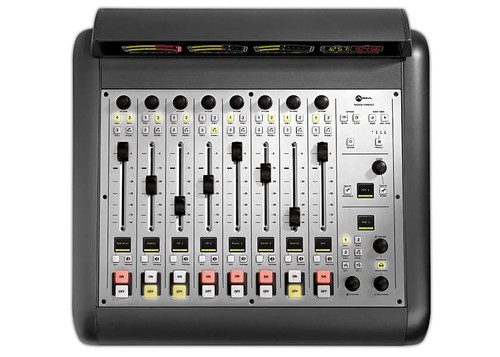
Pulsar is the new, compact mixing console from Axia. Building on the success of our latest full-sized Quasar surfaces, Pulsar delivers the same award-winning features and audio performance in a sleek, compact form factor that prioritizes simple, straightforward installation and operation.
The Pulsar control surface consists of a main unit with 8 motorized faders and a full touchscreen-based monitor section. It can be expanded to up to 16 channels with the addition of the 8-fader expansion unit, which seamlessly and securely connects to the main chassis to create a single, sturdy, and reliable mixer.
Pulsar is powered by the Axia StudioCore™ integrated console engine (sold separately), which combines the console power supply, mixing engine, a dedicated five-port AoIP network switch, and a comprehensive array of audio I/O in a single 2RU rack-mounted package. Its fanless design ensures silent operation, making it ideal for in-studio use. The Pulsar mix engine inside StudioCore provides the same exceptional performance and audio processing quality found in the Quasar engine powering the larger XR and SR surfaces.
A single PoE link connects surface and engine, providing all necessary connectivity, including power, networked I/O via Livewire+ AES67, local analog and digital I/O, GPIOs, and even USB Audio.
Features
- Rugged, reliable, and refined 6th-generation Axia AoIP mixer
- Sleek, compact footprint ideal for studios, newsrooms, portable OB, and remote applications
- Visual Radio friendly: Its dark color and anti-glare finish integrate easily with camera- and lighting-equipped media-focused studios
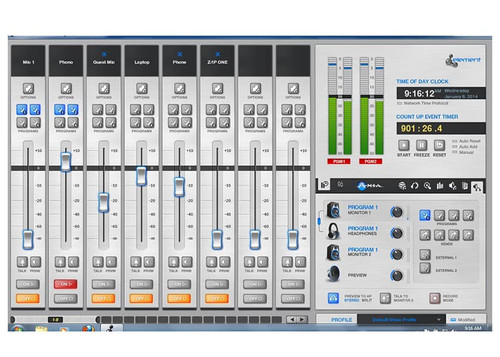
- Easy-to-operate touchscreen-based UI, with no external display required
- HTML5 remote control allows console operation from a standard web browser
- Entire console configuration can be managed from the web-based UI
- 100mm spill-proof motorized faders with 33mm fader pitch for higher fader density and faster hands-on operation
- All faders and encoders are touch-sensitive
- 8-fader (standard) or 16-fader (via expansion module) single or split-frame configurations in table-top or flush-mount design
- Industrial-grade TFT IPS displays (no OLED)
- Customizable color strip on channel displays for easy identification of source groups
- Two user-defined buttons per channel strip
- Two surface layers (access to all 16 channels from an 8-fader surface)
- Master section offers five user-programmable buttons with customized button caps using Pathfinder
- Extensive metering with switchable ballistics built into the surface, including EBU R128 loudness metering; no meter bridge necessary
- Source and Show Profiles for ultimate customization and simple operation
- Mix engine offers up to 16 stereo input channels and the same audio DSP processing quality as Quasar, including high- and low-pass filters, compressor, limiter, expander, gate, de-esser, and 3-band fully-parametric EQ, on all channels
- Flexible and automated audio workflows, including auto mixing, auto mix minus, plus one additional independent V-Mix with 5 stereo inputs
- Optional Pulsar Soft provides HTML5 browser-based remote control and monitoring from any computer, tablet, or smartphone
- Single PoE+ connection links the Pulsar mixing surface and the StudioCore fanless integrated console engine
- Redundant PSU options available in the StudioCore apply to the Surface, the Mix Engine, and the I/Os
- Native Livewire+ AES67 I/O - no licensing, no network I/O limitations
- Future versions will offer Native support for Telos VX® broadcast phone systems and Telos Infinity® intercom platform
- Built on a custom, robust, Linux 64-bit OS embedded on Axia’s latest GEN2 ARM platform
- Ferromagnetic RAM preserves the entire surface state if power is interrupted
- Optional I/O board with 2x Mic In, 1x Stereo Line In, 1x Stereo Line Out, and 1x HP Amp Out
In Depth
Small but Mighty!
Axia Pulsar redefines the world of compact mixing consoles by introducing features and capabilities normally found only on large and expensive broadcast consoles. With its sophisticated feature set driven by an intuitive and simple-to-use workflow, Pulsar allows on-air talent, producers, and contributors to mix, collaborate, and broadcast from anywhere.
Simple and Compact
Pulsar’s compact footprint allows for installation nearly anywhere. A standard 8-channel surface and Axia StudioCore integrated console engine easily fit into a small road case, making it an ideal setup for remote broadcasts.
Pulsar Engine Technology
The Pulsar mix engine running within the StudioCore integrated console engine adopts the new Axia GEN2 Engine technology used in Quasar Engine v4.0, delivering the top-tier audio architecture, processing, audio quality, and overall performance customers expect from an Axia AoIP console. It also leverages our console-to-engine communication protocol, allowing fully interchangeable software banks among hardware units.
The Pulsar engine includes four dedicated stereo program mixes, a dedicated telephone bus, a record bus, and 4 aux busses for phone calls, codecs, and off-air recording, syndication management, and various other applications.
Each fader offers a PFL and AFL feature for previewing sources, automatic mix-minus capabilities, a 3-band fully parametric EQ, dynamics processing (compressor, expander, gate, and limiter), and talkback functionality. Axia’s award-winning gain-sharing automix is included too, providing automatic leveling of multiple on-air microphones for the optimum balance, and to reduce room artifacts and background noise.
Independent studio and control room monitor controls offer a selection of 4 program busses and user-configurable buttons for monitoring external sources, while talent headphone processing allows presenters and talent to tailor what they hear when on the air. Unlimited source profiles and quick-recall show profiles make configuration changes for shows and dayparts simple and convenient. An Optional I/O card adds two microphone inputs, one stereo line input, and an additional headphone amp output directly to the surface.
Native support for Telos VX VoIP broadcast phone systems and the Telos Infinity intercom platform will allow future software versions to add remote control of these products. Native Livewire+ AES67 I/O provides the flexibility to integrate Pulsar into any AoIP environment, and it works seamlessly with our Axia Pathfinder Core PRO broadcast controller to make the most of the routing, control, and logic capabilities of Livewire+.
Pulsar Soft and Pulsar Cast
Pulsar Soft is a powerful browser-based HTML5 remote control tool that represents the entire Pulsar surface on a computer, tablet, or smartphone, and provides remote access to every function of the desk.
Pulsar Cast is a corresponding browser-based HTML5 remote monitoring tool that can stream any Livewire+ channel generated within the console to any computer, tablet, or smartphone, and provide audio monitoring at the remote location.
Together, they form the most powerful solution for driving your studio from a remote location.
Pulsar Soft and Pulsar Cast are available together as a single license option and integrated with the Pulsar surface web UI. They are not available on StudioCore as a standalone application for use without a physical surface.
Superior Build Quality
The products that make up the Pulsar ecosystem are designed and built to withstand the rigors of the broadcast environment. All components have been over-spec’d and carefully selected to adhere to strict tolerances with long life in mind. All parts subject to wear are industrial, automotive, or even avionics-grade. The displays use industrial-grade TFT IPS (full viewing angle) panels; you’ll find no OLED displays here.
Leveraging the Power of Axia’s AoIP Infrastructure
Pulsar connects to Axia’s Livewire+ AES67 AoIP network and takes advantage of its powerful distributed I/O architecture. Livewire+ allows detection, advertisement, sharing, and control of audio resources across multiple studios connected to the network, and its technology complies with the latest AES67 standards.
Specifications / Documents (preliminary)

Faders
- 8x 100mm motorized faders included with the main Pulsar surface
- 16 faders maximum available with the addition of the Pulsar 8-fader expansion unit
16 stereo input channels featuring:
- High-pass and low-pass filters
- Compressor with adjustable threshold, ratio, knee, attack, and release with manual or automatic gain makeup
- Expander/Gate with adjustable threshold, ratio, depth, knee, attack, and release
- Fully parametric EQ with 3x overlapping bands, 20Hz-20kHz
- De-Esser with Axia’s proprietary detection technology
- Low-latency peak limiter
- Axia’s premium gain-sharing Automixer
Up to 36 Stereo Outputs, including:
- 4x Program buses
- Record and Phone buses
- AFL/PFL and Talkback buses
- Control Room and Studio Monitor busses
- 4x Auxiliary buses
- Up to 16 mix-minus (one per channel, automatic)
- 1 VMIX
Connections
- 1x Gigabit Ethernet via RJ-45 LAN connections (PoE+)
- Locking USB-C port for connecting the 8-Fader expansion unit
- HDMI output (mirrors console display on external touchscreen monitor)
- USB-A port (mirrors console display on external touchscreen monitor)
Dimensions
- Compact desktop hardware platform
- Main Unit: 463mm x 396mm x 55mm - 18.22” x 15.6” x 2.16” (W x D x H)
- 8-Fader Expansion Unit: 292mm x 396mm x 55mm - 11.49” x 15.6” x 2.16” (W x D x H)